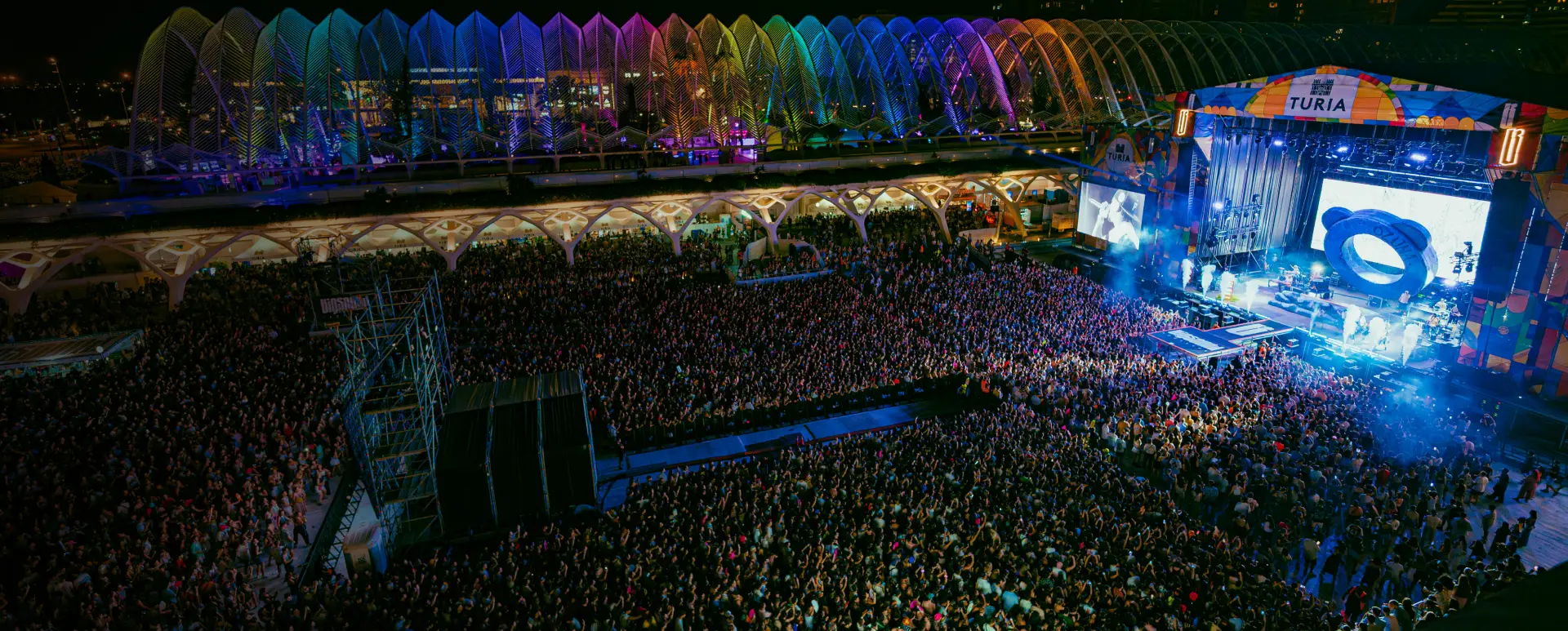
The season ends. You have the numbers from your ticketing platform: 9,800 tickets sold, the venue nearly full, decent revenue. You ran Instagram ads, sent four emails, worked with two local influencers. And now comes the question most promoters can’t answer: what actually worked?
If you don’t know, you’re not measuring. You’re guessing.
Festival marketing metrics aren’t a luxury for large organizations or an obsession for data teams. They’re the difference between repeating what works and continuing to pay for what doesn’t. This guide gives you the complete framework: the 10 metrics that matter, how to calculate them, and how to get started even if all you have today is a spreadsheet.
Running a festival consumes every available unit of mental energy: production, artists, permits, logistics, ticket sales. Marketing gets managed “on the side,” and when the event ends, nobody has time to sit down and analyze what happened.
The result is that most promoters operate on accumulated intuition. “The lineup announcement email always does well.” “Instagram gives us great visibility.” “Paid ads never work for us.” Statements that may be true or completely wrong, but that get repeated because there’s no data to contradict them.
Industry estimates suggest more than 65% of live event promoters have no visibility into which marketing channel generates which percentage of their ticket sales. Not because they don’t want to know, but because nobody has shown them how to measure it, and generic tools aren’t built for the ticketing world.
The consequences are concrete:
- You keep investing in channels that generate noise but not sales
- You don’t know whether your attendee database is a real asset or a list of contacts with no value
- Each edition you start almost from zero instead of building on what you already know
- You can’t show a sponsor the actual reach of your attendee base
The solution isn’t becoming a data scientist. It’s learning to read ten numbers that already exist in your tools, but that nobody has explained how to interpret.
The 10 metrics that matter for measuring festival success
There are dozens of things you can measure. Most of them are noise. These ten are the ones that drive real marketing and business decisions.
Acquisition metrics
These three metrics answer the most fundamental question: how much does it cost to acquire an attendee, and where do they come from?
1. Cost per attendee acquired (CAC)
CAC is how much you spend on marketing for one person to buy a ticket. You calculate it by dividing the total marketing spend on a channel by the number of ticket sales that channel generated.
If you invested €2,000 in Instagram campaigns and can attribute 80 sales to that channel, your Instagram CAC is €25. If your average ticket price is €45, the margin on that acquisition is positive but tight. If your average ticket is €22, you’re losing money acquiring through that channel.
The trap is that most promoters calculate CAC across all marketing combined, not by channel. That produces a number that looks reasonable but hides the fact that some channels work very well and others are a drain.
How to start: Add UTMs to all links in your campaigns — those parameters at the end of the URL like ?utm_source=instagram. This lets you cross-reference clicks with purchases in your ticketing platform or Google Analytics.
2. Conversion rate by channel
CAC tells you how much you pay per attendee. Conversion rate tells you what percentage of traffic from each channel ends up buying.
A channel can drive high traffic with a low conversion rate, or low traffic with a high rate. The second scenario is generally more efficient.
Conversion rate = (Tickets sold from channel / Clicks from channel) × 100
If your email list converts at 4% and Instagram at 0.8%, that says something very clear about where your marketing energy should go.
3. Revenue by marketing channel
Conversion rate and CAC are ratios. Revenue by channel gives you absolute volume: what percentage of your total income comes from each source.
It’s not uncommon to find that 50–60% of a festival’s revenue comes from its email list (people who already know the event), while investment in that channel is minimal compared to what’s spent on ads or social media.
This data reshapes investment priorities dramatically the first time you see it.
Engagement metrics
You have an attendee database. Do you know how many people are actually reading what you send?
4. Campaign open rate
Open rate measures what percentage of your subscribers open your emails. The benchmark for the live events sector is between 22% and 35% for active, well-segmented lists.
A low open rate (below 18%) doesn’t always mean your content is weak. It can mean your database has a lot of inactive contacts, or that your subject lines aren’t specific enough.
Open rate is a measure of database health, not just content quality. A list of 20,000 contacts with a 15% open rate delivers fewer actual messages than a list of 8,000 with a 38% rate.
5. Campaign CTR
CTR (click-through rate) measures what percentage of people who opened your email clicked on a link. It tells you whether the email content moved people to act.
A well-constructed lineup announcement email should have a CTR of 8–15% on opens. A last-tickets reminder email can reach 20–25% if the segmentation is right.
What drives CTR isn’t design. It’s whether the link takes the right person to the right moment with the right message.
6. Audience engagement rate
This metric measures what percentage of your total database is actively interacting with you: opening emails, clicking, visiting the site. It doesn’t matter if you have 5,000 or 50,000 contacts if only 8% engages.
A healthy engagement rate is above 20–25%. Below that, you have a segmentation or content relevance problem — not necessarily a list size problem.
The difference between a large, dormant database and a smaller but active one is enormous in sales outcomes.
Retention metrics
These three metrics have the greatest impact on the long-term sustainability of your festival. And they’re the ones fewest promoters track.
7. Attendee repeat rate
What percentage of this year’s attendees also came last year? This is the most direct measure of your community’s health.
For established festivals, a repeat rate of 25–35% is healthy. Below 20%, you have a retention problem: the event attracts new people but doesn’t keep them. Above 40%, you have a very solid base of returning fans, which reduces your acquisition cost with each new edition.
The marketing impact is direct: returning attendees don’t need convincing that the festival is worth attending. They need to feel recognized and receive early access before the general public. An email to this segment with twice the lead time and an early bird price can sell more in 48 hours than a week of paid campaigns.
For a deeper look at converting one-time visitors into loyal fans who return year after year, the guide on festival attendee retention goes into detail on segmentation and communication strategies.
8. Attendee lifetime value (LTV)
LTV is the total revenue a single attendee generates over their entire relationship with your festival. Add tickets across multiple editions, possible VIP upgrades, merchandise, in-venue spending.
An attendee who comes once might generate €45. A fan who comes 6 editions in a row, upgrades to VIP in the fourth, and buys merchandise could generate €400–600 over the same period.
Why does it matter? Because it changes how you think about acquisition. If you know a recurring fan is worth €500 over 5 years, a €40 CAC to acquire them is an excellent investment. If you only see the value of the first ticket, that same CAC looks expensive.
Most promoters don’t calculate LTV because it requires cross-referencing data across multiple editions. But it’s the number that best explains why building a database is more profitable than spending more on ads every year.
9. Audience churn rate
Churn rate is the percentage of your database that stops engaging with you over a given period: stops opening emails, doesn’t buy for the next edition, unsubscribes.
A churn rate of 15–20% annually is normal for live event databases. Above 30%, you’re losing audience faster than you’re building it, and the problem usually lies in communicating too often (saturation) or at irrelevant moments.
Churn is not solved by sending more emails. It’s solved by segmenting better: contacts who haven’t interacted in more than 12 months need a specific reactivation campaign before you include them in your regular communications — not just another email of the same type.
10. Marketing ROI
Marketing ROI answers the final question: for every euro I invest in marketing, how many euros does it generate in sales?
The formula is: (Revenue attributable to marketing - Total marketing cost) / Total cost × 100
An ROI of 200% means for every euro invested, you generate €2 in net return on investment. For festivals with active, well-segmented databases, the email channel typically delivers ROIs well above 300%, while paid advertising rarely exceeds 100–150%.
The trap with ROI is misattributing revenue. If you sell 5,000 tickets but can only trace the source of 2,000, your calculation is skewed. That’s why acquisition metrics and UTMs are the starting point: without channel traceability, ROI is a number without context.
How to start measuring if you have nothing: the 30-day plan
You don’t need a perfect system to begin. You need to start with the right questions and build incrementally.
Week 1: connect your data sources
The first step is knowing what data you already have and where it lives.
Your ticketing platform has purchase data: name, email, purchase date, ticket type, transaction source. Your email tool has behavioral data: who opens, who clicks, who doesn’t.
Export data from your last two editions as CSV files. With that you can cross-reference by email and calculate your repeat rate. You don’t need to connect anything yet. You need to know what raw material you’re working with.
If your ticketing platform doesn’t export data with email addresses, you have a source problem. Some ticketing platforms withhold buyer contact data from promoters. If that’s your situation, your options are to add a supplementary registration form on your website to capture data directly, or to move to a platform that gives you access to your attendees’ data. The available integrations with ticketing platforms are the starting point for building a real database.
Week 2: run a simple campaign and measure open rate and clicks
Pick your current email tool (Mailchimp, Brevo, whatever you’re using) and send a campaign to your full list. Measure:
- Open rate (how many opened it)
- CTR (how many clicked)
- Unsubscribes (how many opted out)
Those three numbers tell you the health of your list in 30 minutes. You don’t need more to start.
If your open rate is below 15%, your list has too many inactive contacts and before running more campaigns you need to clean it. If it’s above 30%, you have a reasonably active base to work with.
Week 3: cross sales data with campaigns
Add UTMs to all links in the campaign you sent the previous week. If you use Google Analytics or have a tracking pixel on your ticketing platform, you’ll be able to see how many people who opened that email ended up buying.
Even if you can only trace a portion of sales, the pattern that emerges — which email drives more clicks toward purchase, at what point in the week, with which subject line — is already actionable for your next campaign.
Week 4: your first dashboard with the 3 essential metrics
At the end of the month, build a simple document (a Google Sheet works fine) with three numbers you’ll update after each campaign or each edition:
- Repeat rate from the last edition vs the previous one
- Revenue by channel from the last campaign
- Open rate of the last send vs the average of the last 6
These three numbers, read together, tell you whether your database is growing in quality, which channel deserves more investment, and whether your communications are connecting with your audience.
You don’t need more than this to make better decisions than most promoters in the sector.
There’s a temptation to solve the metrics problem by buying new tools. The reality is that tools only help if you’re clear on what you want to measure.
Google Analytics is useful for understanding your website traffic and user behavior before purchase. Its limitations in the events world are well-known: it doesn’t natively cross-reference ticketing data, it doesn’t know who each individual attendee is, and it can’t segment by attendance history.
Excel or Google Sheets are the starting point for most promoters and have real value for one-off analysis. The problem appears at scale: when you have 5 editions of data and 20,000 contacts, manually cross-referencing them every time is unsustainable and error-prone.
A specialized event CRM solves the underlying problem: it centralizes ticketing, email, and behavioral data for each attendee in one place, and calculates these metrics automatically. Tools like Nevent’s CRM for events are designed specifically for this workflow: they connect with your ticketing platform, build each attendee’s profile across editions, and surface retention KPIs without manual work.
The right tool is one that eliminates manual cross-referencing and lets you focus on interpreting and acting, not building pivot tables.
What you don’t need, at least to start, is an enterprise analytics system like Salesforce or HubSpot. They’re not designed for the data flow of a festival, and the cost of adapting them far outweighs the value they provide in this context.
The data you already have is worth more than you think
Every festival you’ve run has generated data. Names, emails, purchase dates, ticket types. That data exists somewhere — in a CSV file or buried in your ticketing platform’s interface — probably without anyone ever having cross-referenced it across editions.
The festival marketing metrics covered in this guide don’t require sophisticated technology to get started. They require the decision that your attendee data is a strategic asset, not an administrative archive.
The first step is knowing how many of your attendees come back. That single number, calculated correctly, changes how you think about your database, your marketing investment, and the value you’re building edition by edition.
How many decisions for next season are you making based on what you remember from the last one — versus what the data would actually tell you?
Frequently Asked Questions
What are the most important metrics to measure festival success?
The most important festival metrics are: attendee repeat rate (what % returns between editions), cost per attendee acquired by channel, email campaign conversion rate, marketing ROI, and attendee lifetime value. If you can only measure three things, start with repeat rate, your top-performing sales channel, and your campaign open rate.
How do I calculate the ROI of my festival marketing campaigns?
Marketing ROI is calculated as: (Revenue generated by campaign - Total campaign cost) / Total cost × 100. To apply this to festivals you need to know which revenue to attribute to each campaign, which requires UTM tracking on your links and cross-referencing sales data with your email or ad campaign data. Without that cross-reference, you only have vanity metrics.
What is festival attendee lifetime value and why does it matter?
Attendee lifetime value (LTV) is the total revenue an attendee generates over their relationship with your festival: tickets across multiple editions, merchandise, VIP upgrades, in-venue spend. An attendee who comes 5 editions in a row and upgrades to VIP can be worth 10x more than a one-time visitor. Knowing this changes how you invest in acquisition: if a recurring fan is worth €600 over 4 years, you can afford to spend more to acquire them.
What's the difference between a KPI and a vanity metric in live events?
A KPI (key performance indicator) is a metric directly tied to a business outcome: sales, repeat attendance, ROI. A vanity metric looks good in a report but doesn't inform decisions: social media followers, post impressions, website visits without cross-referencing sales. In events, the most common vanity metric is social media reach from campaigns. The KPI that matters is how many tickets that campaign actually sold.